Newton
Your way into crypto.
Near instant finality can make a crypto trade feel complete the moment it is placed, even though execution is only the first step. Once a transaction settles, the asset transfer is recorded and depending on the method, it can be held through a network of execution and custody systems. Ownership is established and the mechanics are largely invisible, working behind the scenes for the holder, but forming the foundation for everything that follows.
Many people simply hold their assets. In crypto, they are sometimes referred to as “Hodlers” or as having “diamond hands”. Holding can be an intentional choice rather than a passive one. Some digital assets generate yield without requiring a sale, allowing stakeholders to earn while remaining exposed to price movement. In this context, time itself becomes part of the approach, even when no further action is taken.
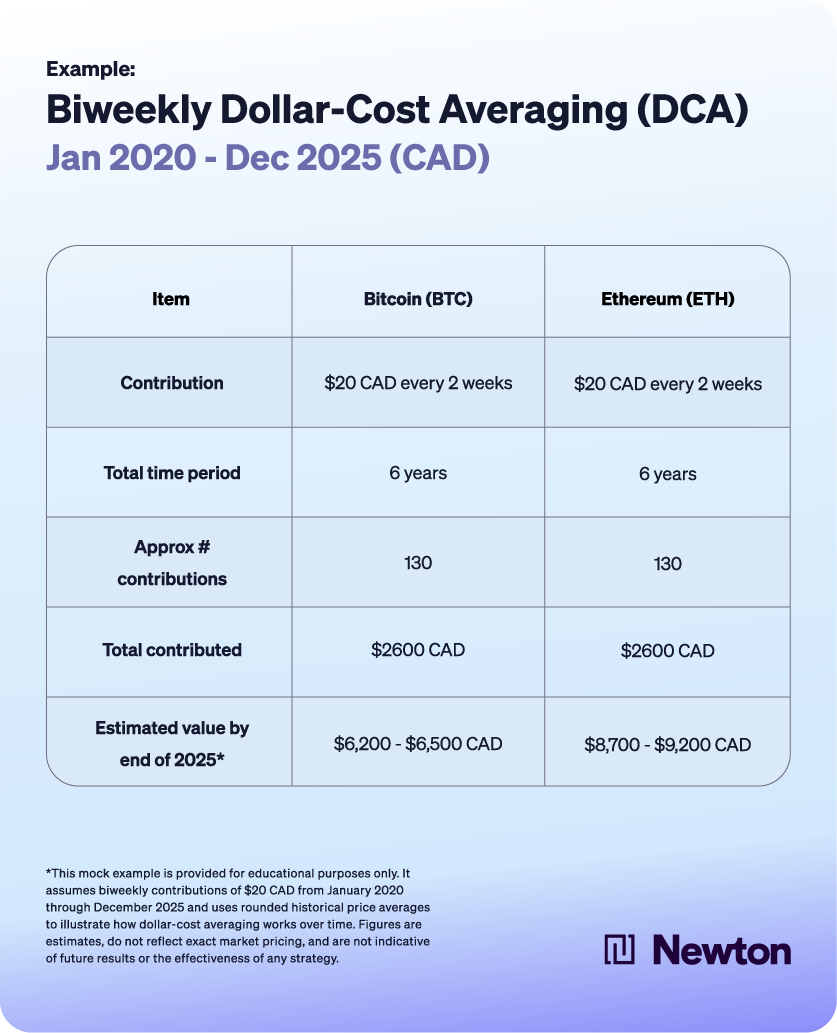
Others continue to build their position after the initial purchase. Recurring buy programs allow additional units of an asset to be acquired automatically over time, often on a set schedule. Instead of reacting to short term price movements, this approach known as dollar-cost averaging emphasizes consistency and gradual exposure over longer time horizons.
A six-year stretch helps illustrate the point. Over that period, our mock investor Jane contributed $20 every two weeks to Bitcoin and Ethereum while experiencing multiple market cycles, including sharp drawdowns and periods of recovery.
Liquidation remains an option throughout the lifecycle of ownership. Selling may occur in response to market changes, personal financial needs, or shifts in allocation priorities. Exiting a position does not necessarily signal success or failure. You can exit through market orders, where you accept the price the market is offering at that given time or through limit orders where you sell if the market meets the price you have set in your order.
Some digital assets introduce staking as a possibility. Staking is a way to earn on crypto you already own. When you commit tokens by locking them you may help to validate transactions and keep the blockchain network secure. This is one of the key components of the Proof of Stake (PoS) consensus mechanism. In exchange, you may receive rewards in the form of more crypto assets typically issued in the same cryptocurrency as the staked asset.
Governance rights are sometimes associated with crypto ownership. In some proof-of-stake systems, voting requires tokens to be delegated or locked, which can involve giving up aspects of custody. Newton does not currently support voting features on our platform.
Throughout all of these choices, record keeping continues in the background. Each transaction generates data, including timestamps, cost basis, transfers, and disposition events. Buying, selling, staking, earning yield, and receiving rewards may all carry different reporting implications depending on your situation. As tax frameworks continue to update, many individuals monitor activity on a quarterly basis simply to maintain clarity while others delegate this work to financial accountants.
For Canadian taxpayers, activity that occurs during the 2025 calendar year must be reported by the individual during the 2026 tax filing season, with deadlines currently extending into April. Preparation often begins well before filing, as transaction histories may span multiple platforms, wallets, and forms of participation. In 2023, Newton integrated with Koinly in an effort to make reporting easier for our users. Rules and classifications for digital assets depend on how the activity is viewed under Canada Revenue Agency guidelines.
What happens after a trade is like a choose your own adventure book. It is a sequence of quiet decisions shaped by comfort, your individual risk tolerance, and time horizon. The systems and service providers support execution, but it’s the individual who defines what ownership means to them.
If you enjoyed reading this, explore more Canadian-focused cryptocurrency information and education on the Newton blog.


.png)
.png)